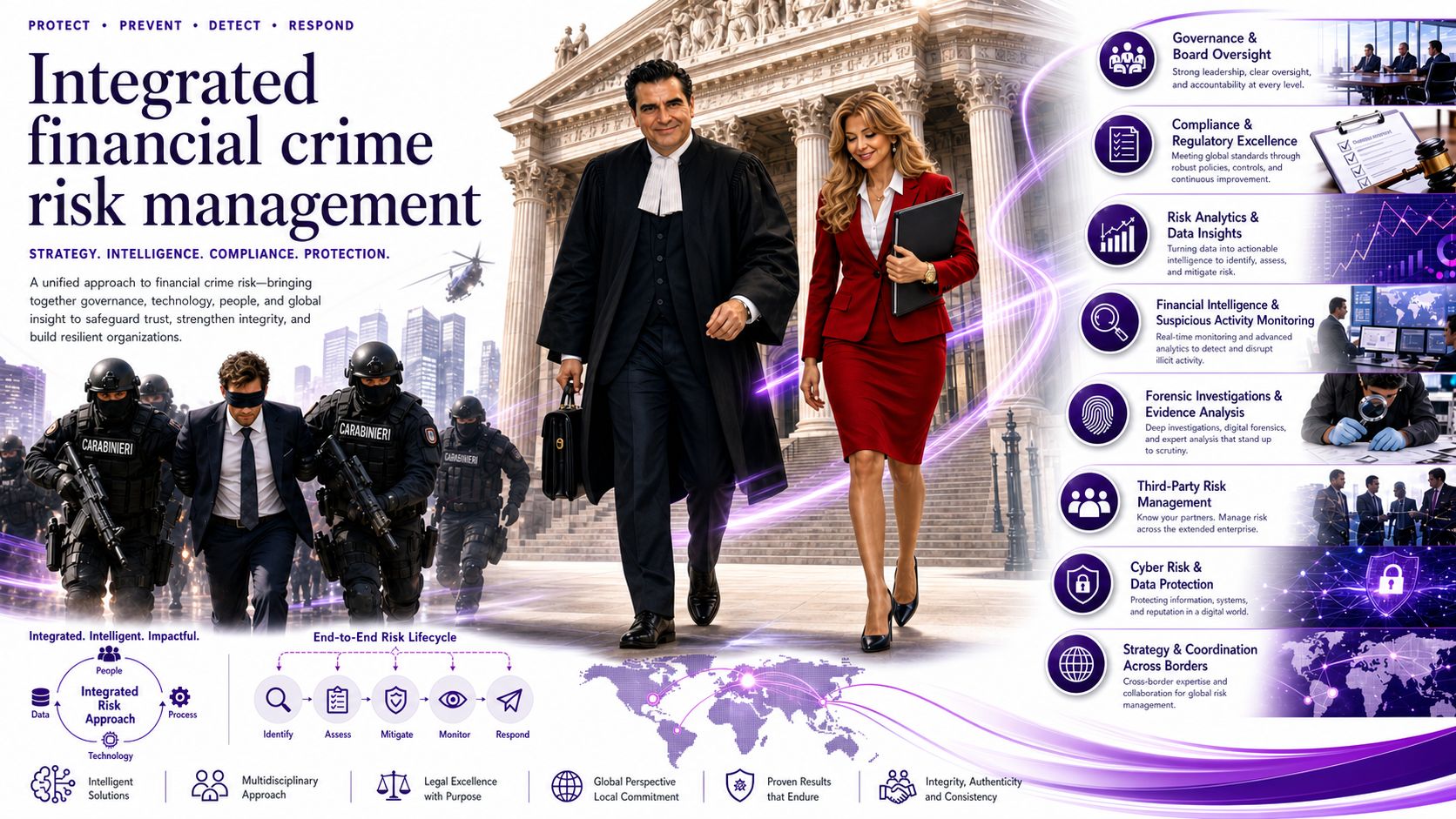


Integrated Financial Crime Risk Management, when approached through a Whole-of-Strategic-Resilience framework, must be understood in the context of contemporary governance, market dynamics, geopolitical tension, technological restructuring, and institutional pressure as a mode of administrative and normative ordering that extends far beyond traditional notions of compliance, detection, incident response, or post hoc enforcement. Within such a framework, financial crime is situated not only within the domain of legal violations, illicit financial flows, sanctions evasion, corrupt influence, money-laundering structures, fraudulent chains, or the abuse of legal and financial infrastructures, but within the broader and considerably more consequential domain of the strategic conditioning of decision-making space. The central question is therefore not limited to whether an organization, sector, or state is capable of detecting criminal or irregular financial flows, mitigating disproportionate risks, or limiting legal liability. The central question shifts toward whether the architecture of financial and economic integrity is designed in such a way as to prevent ostensibly legitimate relationships, investments, contractual entanglements, ownership structures, data dependencies, platform integrations, intermediary networks, and financing arrangements from gradually creating a situation in which formal freedom of decision appears to remain intact, while material freedom of action has already been conditioned by external or opaque interests. In that sense, Integrated Financial Crime Risk Management assumes a place at the center of strategic governance: not as a peripheral consideration that enters the picture only after commercial choices have already been made, but as a constitutive element of the question whether a system still genuinely governs itself under pressure, or merely reacts within a decision space narrowed by dependency, exposure, and concealed influence.
From that perspective, a Whole-of-Strategic-Resilience framework implies that strategic resilience cannot be reduced to crisis resistance, recovery capacity, or operational continuity in any narrow sense. In this context, strategic resilience concerns the capacity to continue determining one’s own direction of development under conditions of persistent uncertainty, adaptive threat, economic pressure, normative erosion, and institutional overload; to recalibrate priorities without administrative dislocation; to restructure dependencies before they become irreversible; and to preserve the legitimacy of decision-making in an environment in which speed, expediency, and external pressure constantly compete with prudence, integrity, and long-term autonomy. Financial crime risks thereby acquire an entirely different layer of meaning. They are no longer viewed solely as risks of fines, reputational harm, supervisory intervention, or incident-driven disruption, but as carriers of cumulative systemic distortion. A financial or economic relationship may appear entirely lawful and yet still create the conditions for future influenceability. An investment decision may, at the moment it is made, appear rational and market-conforming, while simultaneously reorganizing the governance of critical assets in a manner that diminishes future strategic freedom of choice. A technology provider, correspondent bank, logistics partner, data intermediary, or capital provider may generate operational value while at the same time creating an access point for normative weakening, information asymmetry, contractual lock-in, or tacit shifts in power. In that light, Integrated Financial Crime Risk Management becomes an instrument for guarding the boundary between productive openness and destabilizing entanglement, between legitimate economic integration and administrative hostage-taking, and between seemingly efficient dependency and the structural erosion of strategic autonomy.
Strategic resilience as the capacity for evolution and agility
Within the framework of Integrated Financial Crime Risk Management, strategic resilience must be understood as an evolutionary capacity rather than merely a defensive characteristic. That distinction is decisive, because an organization or system that approaches financial integrity exclusively through the lens of stability, control, and incident prevention lacks sufficient visibility into the way in which the threat environment itself is continually transforming. Financial crime does not develop in a linear fashion, nor is it static, nor does it remain confined to the contours of already familiar typologies. Capital flows, legal structures, ownership chains, digital payment mechanisms, trade channels, trust and holding arrangements, technologically enabled intermediaries, and cross-border contractual frameworks evolve continuously under the influence of geopolitics, market pressure, sanctions regimes, innovation, datafication, and regulatory arbitrage. A system that can withstand only familiar risks, yet is unable to reconfigure itself conceptually, institutionally, and operationally as the nature of dependency and infiltration changes, does not possess strategic resilience in the full sense. Within a Whole-of-Strategic-Resilience framework, resilience therefore signifies the capacity not merely to absorb threats, but to reorganize the system’s own governance architecture, risk perception, decision-making routines, control methods, and priority structures in a timely manner once previous assumptions concerning reliability, transparency, market neutrality, or supply-chain security are no longer sustainable.
That understanding has far-reaching implications for Integrated Financial Crime Risk Management. When financial integrity is conceived as a more or less fixed set of norms, processes, and controls, the result is often a model that is strong in repetition and weak in strategic adaptation. In such a model, control is measured by the extent to which existing procedures have been correctly applied, while insufficient attention is given to whether the underlying risk logic on which those procedures are built still corresponds to the actual configuration of exposure. An organization may demonstrably possess mature customer acceptance procedures, transaction monitoring, third-party due diligence, and escalation mechanisms, yet still remain vulnerable because the actual threat has shifted toward ownership influence, silent governance accumulation, contractual lock-in, access to data, informal market power, or the concentration of dependencies in infrastructures lying beyond the classic compliance field of vision. Strategic resilience as a capacity for evolution therefore requires that Integrated Financial Crime Risk Management not merely assess whether the organization acts consistently within existing frameworks, but also whether those frameworks themselves remain strategically adequate under changing circumstances. The integrity architecture must be capable of adapting to new patterns of concealment, to the convergence of financial and technological threats, to changing sanctions dynamics, to the political instrumentality of capital, and to the gradual blurring of the distinction between economic partnership and structurally embedded influence.
Agility, accordingly, is not a discretionary management virtue but a core requirement of institutional survival. Agility in this setting does not mean impulsiveness, nor a permanent condition of tactical improvisation. It means the capacity to recognize at an early stage when the conditions under which earlier choices were rational have materially changed, and then to possess sufficient institutional room to alter course without paralyzing delay, reputational fear, sunk-cost thinking, or internal compartmentalization of expertise. In an environment in which financial and economic influence frequently presents itself in the form of investment, efficiency, innovation, scale advantage, or market access, strategic resilience can only be credible if it also includes the resolve and analytical capacity to reassess apparent benefits in light of longer-term risks to autonomy and normative control. Integrated Financial Crime Risk Management then functions as the discipline that identifies where evolution is necessary, where existing dependencies must be reconsidered, and where institutional agility makes the difference between temporary exposure and structural weakening of strategic position.
Strategic resilience beyond crisis response and short-term recovery
One of the most significant limitations of traditional resilience models is that they treat resilience primarily as the ability to absorb disruption and then return to a prior state of affairs. From the perspective of a Whole-of-Strategic-Resilience framework, that conception is fundamentally inadequate. In the domain of financial and economic integrity, the most consequential threats are not always abrupt, visible, or incident-based. They often operate gradually, relationally, and cumulatively. They do not necessarily present themselves as acute crises requiring emergency measures, but instead manifest through the gradual reordering of dependencies, information positions, investment relationships, contractual power, access to data, and the capacity to influence. Under such circumstances, an organization may appear fully stable in operational terms while nonetheless losing strategic ground. A model that links resilience exclusively to business continuity, incident management, or post-disruption recovery risks overlooking precisely those forms of conditioning that are most decisive over the long term. The relevant question is therefore not whether the system functions again after a shock, but whether it has quietly begun to function within parameters no longer determined by legitimate, transparent, and governable interests.
Against that background, Integrated Financial Crime Risk Management acquires an explicitly preventive and forward-looking character. It must contribute not only to the management of identified incidents, but also to the recognition of structural shifts that have not yet come to be experienced as crises and are therefore easily underestimated at the administrative level. This includes situations in which a source of financing gradually acquires disproportionate influence over investment sequencing or asset prioritization, in which a third party becomes a de facto gatekeeper with respect to data or transactions through deep process integration, in which a series of individually permissible exceptions erodes the normative profile of customer or partner acceptance, or in which strategic assets are increasingly surrounded by legal structures that provide formal transparency while materially obscuring where ultimate influence resides. In none of these cases is a clear incident in the narrow sense required. Yet the totality may nonetheless produce a condition in which the autonomy of future decision-making is significantly reduced. A resilience concept confined to crisis response perceives such developments too late, because it activates only once dependency has already consolidated.
For that reason, strategic resilience requires an orientation toward durable positioning rather than mere restoration of the status quo. Recovery is not necessarily a desirable objective when the condition to which recovery occurs already contained structural vulnerabilities. A system may, after an incident, restart all processes, restore liquidity, continue contracts, and contain reputational damage, while the underlying configuration of exposure remains untouched. From the standpoint of Integrated Financial Crime Risk Management, every disruption, every near-miss signal, every escalation pattern, and every abnormal transactional or partner profile must therefore be read as a potential symptom of deeper architectural weakness. Strategic resilience beyond short-term recovery means that the system is capable of reassessing its own point of departure, reconsidering the desirability of earlier dependencies, and implementing structural adjustments that reduce future susceptibility to capture. The focus thereby shifts from reactive recovery to the active reordering of governability, integrity, and room for maneuver.
The capacity to reinterpret changing threats at an early stage
No system possesses durable strategic resilience if it recognizes threats only in the forms in which they have historically already appeared. In the domain of financial crime, the capacity for early reinterpretation is therefore a core precondition for effective governance. Threats do not change only in intensity; they also change in form, in their cloak of legitimacy, in their institutional packaging, and in their relational embedding. What was once recognizable as a classic money-laundering or corruption risk may later present itself as a private investment, a technology partnership, a preferred supplier relationship, a joint venture structure, a consultancy layer, or a cross-border financing solution with ostensibly market-conforming characteristics. By the same token, a supply-chain risk may evolve into an ownership and governance issue, while an operational continuity risk may gradually become a financial crime access point because information, transactions, access rights, and contractual authorities converge in the same location. A system that fails to reinterpret these shifts in a timely manner continues to look through outdated categories and underestimates the extent to which threat actors, opportunistic market parties, or politically instrumentalized capital flows exploit precisely those boundaries between disciplines on which traditional organizational structures rely.
For Integrated Financial Crime Risk Management, this means that signaling can never consist merely in the collection of indicators within predetermined control fields. What is required is an interpretive capacity capable of reading patterns across functions and of assessing anomalies not only in terms of procedural irregularity, but also in terms of their possible strategic significance. A change in beneficial ownership, a sudden shift in contractual terms, an apparently attractive financing structure, a new intermediary layer, increasing dependence on a single technological ecosystem, or a series of transactions that are individually explainable yet collectively form an unusual concentration pattern must all be capable of being understood as signals of a changing threat logic. Early reinterpretation therefore requires more than technical monitoring. It requires institutional intelligence: the ability to combine legal, financial, operational, geopolitical, and technological information into a strategically usable picture of emerging influenceability. Where that capacity is absent, warning signs remain fragmented, are reduced to specialist anomalies, and reach the governance level in their strategic significance only once meaningful options for action have already narrowed.
The capacity for reinterpretation is also closely connected to the willingness to question familiar assumptions. Many organizations and systems do not primarily suffer from a lack of data, but from an excess of stabilizing assumptions concerning markets, partners, jurisdictions, investors, infrastructures, and intermediaries. So long as existing relationships generate economic returns, support operational continuity, or feel institutionally familiar, there is a strong tendency to rationalize signals of shifting threat as exceptions, administrative deviations, or manageable complications. Strategic resilience therefore requires a governance culture in which rereading the environment is not treated as a sign of alarm, but as a normal discipline of sound administration. In that context, Integrated Financial Crime Risk Management assumes the role of early translator of ambiguous signals into strategic implications. Its task is not to securitize every complex pattern as a threat, but to prevent administrative inertia, commercial habituation, or functional compartmentalization from causing relevant threat shifts to be recognized only after dependency has already become institutionalized.
Agility in governance, prioritization, and decision-making
Strategic resilience loses all practical meaning if it is not embedded in governance, prioritization, and decision-making. This is especially true within Integrated Financial Crime Risk Management, because the most serious risks rarely present themselves as isolated compliance matters that can be handled at the bottom of the organization. They bear directly on investment choices, product architecture, market entry, third-party selection, sourcing models, technological integration, ownership restructuring, geographic positioning, and the allocation of governance attention. When governance treats these issues as separate columns, the result is an administrative picture in which economic rationality, risk control, security, continuity, and integrity exist side by side without revealing where they actually condition one another. Agility in governance therefore means that the board and senior management are capable of shifting priorities once it becomes apparent that issues of financial and economic integrity carry strategic implications extending beyond the function initially concerned. It concerns the institutional capacity to escalate signals, revise assumptions, accelerate decision pathways, and reconsider previously accepted exposures when the surrounding context changes.
Within that logic, prioritization becomes an exercise in strategic differentiation rather than a mere ranking of risks according to abstract likelihood and impact. Not every financial integrity risk is equally relevant to strategic resilience, and not every high-volume compliance issue constitutes a threat to administrative autonomy. The most decisive questions are often those risks that coincide with critical dependencies, concentrated access points, assets of systemic value, infrastructures with high degrees of lock-in, or relationships that combine economic value with information and influence power. Governance must therefore be able to distinguish between risks that primarily call for operational control and risks that require the revision of strategy, partnerships, investment sequencing, or market exposure. In that regard, Integrated Financial Crime Risk Management provides not only control information, but also a framework for normative judgment: which forms of exposure are technically manageable yet strategically undesirable, which relationships are legally permissible but institutionally too costly, and which exceptions undermine over time the capacity to make future choices in a credible and autonomous manner. Agility in prioritization thus means a willingness to treat integrity not as a residual category, but as a measure of the durability of broader strategic choices.
Decision-making under conditions of uncertainty ultimately requires a form of governance that leaves room for timely correction without producing decision paralysis. Governance that is too rigid can suffocate signals within formal pathways; governance that is too loose can lead to opportunistic inconsistency and normative erosion. Strategic resilience therefore calls for a middle position in which clear responsibilities, escalation lines, and assessment frameworks are combined with the capacity to scrutinize exceptions critically, to revisit decisions periodically, and to translate new information rapidly into adjusted courses of action. Within Integrated Financial Crime Risk Management, this means, among other things, that decisions concerning markets, clients, partners, transactions, investments, and technology are evaluated not only by reference to immediate yield or legal permissibility, but also by reference to the future dependencies they create and the governance space that may later be lost as a consequence. Agile governance is, in that sense, not a procedural luxury, but the mechanism through which an organization or system prevents seemingly rational decisions from accumulating into a pattern of strategic self-limitation.
Scenario thinking, adaptive strategy, and institutional learning capacity
Within a Whole-of-Strategic-Resilience framework, scenario thinking performs a function far more fundamental than that of conventional strategic planning or crisis preparation. In the context of Integrated Financial Crime Risk Management, it serves as a method for rendering conceivable the ways in which ostensibly legitimate economic configurations may, under changing circumstances, transform into structures of influence, dependency, or quiet destabilization. Traditional risk models tend to proceed from linear projections, familiar categories, and relatively stable causal relationships. The domain of financial crime, particularly where it intersects with geopolitics, technological change, and institutional complexity, can increasingly no longer be understood adequately through such linear assumptions. Scenario thinking is therefore necessary in order to make visible which combinations of events, policy changes, market reordering, sanctions expansion, ownership transformations, concentration of digital infrastructure, or contractual shifts may lead to a disproportionate erosion of strategic autonomy. The importance of such scenarios does not lie in predictive exactness, but in their ability to discipline strategic imagination and expose where the system currently relies on assumptions that may fail rapidly under pressure.
Adaptive strategy builds on that foundation by recognizing that not every relevant threat can be fully quantified in advance or translated into fixed policy responses. A system seeking to be strategically resilient must therefore possess not only scenarios, but also mechanisms through which it can genuinely alter course on the basis of new information. This is especially true in Integrated Financial Crime Risk Management, where signals are often ambiguous, fragmented, and only meaningful once read together. Adaptive strategy requires that governance not cling rigidly to previously formulated risk appetites, growth objectives, or partner selections when the context has materially changed. It requires that decisions concerning investment, outsourcing, technology, market exposure, or capital structure be approached as provisional positionings that must periodically be reassessed in light of emerging threat landscapes. In this way, it becomes possible to avoid policy inertia, to prevent historical choices from becoming normatively untouchable, and to avoid tying institutional reputation to the maintenance of relationships and configurations that are becoming progressively harder to defend strategically.
Institutional learning capacity forms the third pillar of this approach and is, in many organizations, also the most underestimated. Without learning capacity, scenario thinking becomes an exercise and adaptive strategy a matter of rhetoric. Institutional learning capacity means that signals, incidents, near misses, escalations, audit findings, due diligence outcomes, changing market conditions, and external warnings are genuinely processed into the architecture of policy, governance, and decision-making. That requires more than lessons-learned memoranda or periodic evaluations. What is required is an institutional infrastructure capable of recognizing patterns, connecting comparable forms of case experience across business units or supply chains, making implicit assumptions explicit, and remaining willing to draw difficult conclusions about previous choices. In the context of Integrated Financial Crime Risk Management, this is essential because many of the most serious vulnerabilities do not arise from a single error or a single norm violation, but from repeated signals that are handled in isolation and therefore never mature into strategic insight. A learning system does the opposite: it turns dispersed information into a source of administrative correction and thereby strengthens the capacity not only to survive under pressure, but to preserve and reshape strategic space actively.
Strategic repositioning under transition, disruption, and uncertainty
Strategic repositioning constitutes, within a Whole-of-Strategic-Resilience approach, one of the most demanding implications for Integrated Financial Crime Risk Management, because this approach does not proceed from the fiction that the external environment is only temporarily disrupted and then returns to a recognizable equilibrium. In reality, organizations, sectors, and states are confronted with a persistent condition of transition in which geopolitical relationships shift, markets fragment, technologies become obsolete more rapidly, regulatory frameworks are tightened or, conversely, deployed strategically, and economic dependencies acquire a political and normative significance different from that which they previously carried. Under such conditions, an organization’s existing strategic profile may remain operationally usable for some time, while the assumptions underlying it have already been eroded. What yesterday appeared to be efficient integration into an open market may tomorrow prove to amount to an excessively deep embedding in vulnerable or politically exploitable dependencies. What was previously regarded as a rational sourcing relationship may, under conditions of scarcity, sanctions, technological rivalry, or concentration of ownership, develop into a structural limitation on administrative freedom of action. In that context, strategic repositioning means that Integrated Financial Crime Risk Management is not tasked merely with making existing configurations safer, but must also contribute to the question whether certain configurations remain sustainable at all.
That requires a considerably broader interpretation of financial and economic integrity than is customary in traditional models. Not only transactions, clients, or counterparties must be assessed, but also the strategic placement of assets, the structuring of partnerships, the allocation of access to critical data, dependence on legal and financial intermediaries, the geographic distribution of contractual chains, and the extent to which ownership and financing structures still fit within an acceptable profile of administrative autonomy. In a period of disruption, an organization cannot suffice with the observation that existing relationships have been lawful, commercially attractive, or historically reliable. The relevant question shifts to the extent to which those relationships leave room for a change of course when the environment turns. A dependency that under stable conditions appeared efficient and manageable may, under accelerating transition, become an obstructive factor for necessary strategic adaptation. Integrated Financial Crime Risk Management must therefore be capable not only of identifying abuse, but also of making visible the boundary at which legitimate economic interdependence gives way to a configuration that makes repositioning more difficult or more protracted.
Under conditions of uncertainty, this function becomes even more important, because decision-making necessarily takes place on the basis of incomplete information, competing time horizons, and tensions between short-term continuity and longer-term resilience. Strategic repositioning in such circumstances requires an integrity architecture that is not merely defensive and controlling, but also selective, structuring, and directive. It must be able to indicate where exposure is so concentrated that the organization in fact has too little room for maneuver, where contractual lock-in impairs the freedom to correct course, where technological integration creates a disproportionate position of influence, and where relationships that appear separate in isolation together form a pattern that, under altered circumstances, may be used for pressure, evasion, or conditioning. Whole-of-Strategic-Resilience thus makes clear that strategic repositioning is not an optional exercise in corporate agility, but a governance necessity in an environment in which financial and economic vulnerability can shift rapidly from a manageable risk into a structural limitation on future decision-making space. Within that framework, Integrated Financial Crime Risk Management becomes an essential source of discernment between those exposures that remain productive and governable and those that, under the pressure of transition and disruption, develop into constraining or destabilizing forms of dependency.
The relationship between strategic resilience and administrative legitimacy
Strategic resilience cannot exist durably without administrative legitimacy, because resilience ultimately depends not only on resources, infrastructures, procedures, or crisis mechanisms, but also on the extent to which decisions are experienced as lawful, explainable, proportionate, and normatively defensible. In the domain of Integrated Financial Crime Risk Management, this relationship is especially strong, since financial integrity touches on trust in institutions, predictability of decision-making, equality in the application of norms, and the conviction that economic and administrative choices are not quietly dominated by hidden interests, opaque structures, or opportunistic exceptions. Once the impression arises that integrity standards are being applied flexibly in favor of commercial pressure, geopolitical expediency, political proximity, or institutional convenience, the system loses not only normative credibility but also strategic effectiveness. Without legitimacy, the willingness to accept difficult choices diminishes, mistrust grows regarding the motives underlying risk decisions, and the space for implementing necessary adjustments under pressure becomes smaller.
Within a Whole-of-Strategic-Resilience approach, this means that Integrated Financial Crime Risk Management is more than an internal control mechanism; it is also an instrument for safeguarding the credibility of the governing order itself. That applies both internally and externally. Internally, the question is whether management, oversight functions, control functions, and operational lines can rely on consistent norm-setting, transparent escalation, and a recognizable balancing of return, risk, and integrity. Externally, the question is whether investors, clients, citizens, supply-chain partners, supervisors, and other stakeholders can assume that financial and economic relationships are governed according to principles that do not shift arbitrarily once pressure intensifies. A system that speaks of integrity under normal conditions but silently applies broader norms in times of scarcity, growth pressure, or geopolitical tension undermines its own basis of legitimacy. That erosion is strategically dangerous because it weakens the coherence between norm, decision, and execution. Administrative resilience therefore requires not only the capacity to act, but also the capacity to explain why certain exposures are refused, why some partnerships do not fit within the desired integrity profile, and why not every legally permissible or economically profitable option is compatible with sustainable governability.
The relationship between resilience and legitimacy becomes even more acute when an organization or system must operate under heightened pressure. It is precisely then that the temptation arises to reduce integrity to an instrumental issue subordinate to speed, continuity, or geopolitical opportunism. In the short term, such an approach may appear attractive. In the longer term, however, it undermines the capacity to provide direction without having constantly to compensate for loss of trust. Administrative legitimacy in this context is not a symbolic value existing alongside strategy, but a condition for the executability and sustainability of strategic choices. Integrated Financial Crime Risk Management contributes to that by performing a disciplining function: it keeps the normative lower boundary visible, even when the external environment exerts pressure in favor of relaxation, exception logic, or risk displacement. This makes clear that strategic resilience consists not only in the capacity to adapt under threat, but equally in the preservation of a credible governing identity that prevents adaptation from degenerating into normative loss and prevents flexibility from becoming arbitrariness.
Strategic resilience as the bridge between vision and executability
Many strategic programs fail not because the vision is inadequate, but because the connection is missing between abstract ambition and institutional executability. Within a Whole-of-Strategic-Resilience approach, strategic resilience must therefore be understood as the bridge between what an organization, sector, or state seeks to achieve and what remains in fact governable under conditions of dependency, uncertainty, and adaptive threat. This bridging function is particularly relevant for Integrated Financial Crime Risk Management, because financial and economic integrity is often treated as a corrective mechanism after the fact, whereas its real significance becomes visible precisely in the phase in which vision is translated into partnerships, investments, technology choices, market access, capital structure, and operational design. Once that translation takes place without a robust integrity analysis, the risk arises that ambitious strategic objectives are built on configurations that later undermine their own executability. Growth may deepen dependency. Innovation may open undesirable access points. Internationalization may diffuse legal and financial exposure without sufficient visibility into who acquires material influence, and where. The bridge between vision and executability therefore requires a form of strategic resilience that does not activate only once friction becomes visible, but already tests at the design stage whether the chosen route preserves later freedom of action.
Within that bridging function, Integrated Financial Crime Risk Management performs an ordering role. It makes visible where the realization of strategic ambitions rests on assumptions concerning transparency, reliability, political neutrality, contractual enforceability, or technological controllability that are in reality far less stable than presumed. In doing so, it prevents vision from being confused with administrative possibility. An organization may, for example, develop a compelling strategy around digital transformation, cross-border expansion, supply-chain optimization, or capital-intensive growth, yet that strategy quickly loses executability when it becomes dependent on intermediaries with unclear ownership profiles, on jurisdictions with weak enforceability, on platform providers with deep informational power, or on financing structures that hinder later repositioning. Strategic resilience then functions as a touchstone: not to restrain vision, but to anchor it in realistic and sustainably governable conditions. Whole-of-Strategic-Resilience thus shows that integrity does not operate as an external limitation on strategy, but as an internal condition of its material credibility.
The bridge between vision and executability also has a temporal dimension. Many strategic choices are justified on the basis of expected medium-term benefits, while the integrity consequences only manifest themselves later in the form of lock-in, normative erosion, information asymmetry, or dependence on relationships that are difficult to replace. A vision that is coherent in theory may derail in practice when the intermediate stages of execution fail to account sufficiently for the cumulative build-up of exposure. For that reason, Integrated Financial Crime Risk Management must be deployed not only in the assessment of individual transactions or partners, but also in the architecture of strategic implementation. Which sequence of execution preserves opportunities for correction. Which contractual design preserves room for maneuver. Which governance structure ensures that early signals of undesirable dependency actually lead to adjustment. Which investment structures prevent choices that appear efficient from later proving costly in terms of autonomy and governability. In that respect, strategic resilience is the discipline that ensures that vision does not remain suspended in abstraction and executability does not degenerate into opportunistic improvisation, but that both are connected within an integrity architecture that brings direction, realism, and durability into alignment.
Integrated Financial Crime Risk Management as a carrier of strategic adaptability in the transition economy
The transition economy is characterized by the convergence of structural shifts that compel organizations and systems to reorder their economic logic, operational design, and administrative priorities. Digitalization, the energy transition, reindustrialization, the restructuring of global value chains, scarcity of critical raw materials, financial fragmentation, technology politics, and intensified security and sanctions regimes make clear that the context in which economic decisions are made can no longer be understood as a relatively stable market environment with incidental disruptions. In such an environment, strategic adaptability becomes a primary administrative requirement. That adaptability, however, cannot be sustained by flexibility alone. It requires a disciplining infrastructure that helps determine which relationships, investments, financial channels, ownership configurations, and supply-chain linkages support transition without undermining the conditions for later autonomy. Integrated Financial Crime Risk Management thereby assumes a much heavier role than that of traditional gatekeeping. It becomes a carrier of strategic adaptability because it helps distinguish between those forms of economic interdependence that enable transition and those that quietly render transition dependent on opaque, manipulable, or normatively unstable structures.
This role is essential because the transition economy generates numerous incentives to marginalize questions of integrity. High investment needs, pressure to accelerate, competition for technology and raw materials, the necessity of scaling up, and politically directed reallocation of capital together create a climate in which speed and access often outweigh in-depth scrutiny of underlying ownership, financing, intermediary layers, and the strategic side effects of new partnerships. As a result, a situation may arise in which economic transition does indeed advance, but increasingly rests on connections that later prove to develop into administrative or operational vulnerability. In this context, Integrated Financial Crime Risk Management functions as a corrective against transition romanticism and market opportunism. It forces the question whether the means through which adaptation is financed and organized are also compatible with the desire to remain autonomous in steering over the longer term. In this way, it protects not merely against criminal wrongdoing, but against a deeper danger: that the route to renewal simultaneously becomes the route to new dependency.
As a carrier of strategic adaptability, Integrated Financial Crime Risk Management must therefore be integrally connected with investment decisions, technology adoption, third-party governance, supply-chain redesign, data infrastructure, M&A activity, and international positioning. It must enable the organization or system to ask not only whether a transition initiative is feasible and profitable, but also whether it remains administratively reversible, whether the source of financing may later exert pressure, whether the chosen partners leave room for a change of course, and whether the accumulation of individual projects causes a broader shift in power or dependency. In a transition economy, adaptability is durable only when it is not driven by fragile, concealed, or strategically exploitable configurations. Whole-of-Strategic-Resilience therefore makes clear that Integrated Financial Crime Risk Management does not stand at the margins of economic renewal, but at the center of the question how renewal can be organized in such a way that it does not end in administrative weakening. It protects the possibility of further adaptation by preventing the first phase of transition from being financed or structured in a manner that substantially impairs later independence.
Strategic resilience as a condition for sustainable system steering
Sustainable system steering presupposes more than administrative intent, legal authority, or operational capacity. It presupposes a condition in which an organization, sector, or state possesses sufficient autonomy, legitimacy, informational position, normative consistency, and adaptive capacity to continue providing direction to its own development even under sustained pressure. From a Whole-of-Strategic-Resilience perspective, it thus becomes clear that strategic resilience is not a derivative quality of good governance, but a basic condition for it. Without strategic resilience, system steering may appear temporarily effective, while in reality the determining boundary conditions are being shaped elsewhere: in opaque ownership structures, in financial networks that build hidden leverage, in technological dependencies that restrict decision space, in intermediary relationships that distribute information asymmetrically, or in investment patterns that systematically narrow the space for later repositioning. In such situations, the form of governance remains in place, but the material content of steering gradually shifts toward forces and interests that are only partially visible and difficult to correct.
In this regard, Integrated Financial Crime Risk Management has a constitutive function for sustainable system steering. It protects not only against direct abuse, but also safeguards the conditions under which steering still retains meaning. Where financial and economic integrity is insufficiently embedded, the risk arises that choices formally remain within the powers of the governing body, while in substance they are already preprogrammed by existing exposures, contractual asymmetries, financing structures, or technological lock-ins. A governing body may then still take decisions, but no longer choose freely among genuinely open alternatives. Sustainable system steering therefore requires an integrity architecture that systematically maps where power, information, access, and economic influence are concentrated, where dependencies deepen, and where normative boundaries begin to shift under the pressure of efficiency, speed, or scarcity. Integrated Financial Crime Risk Management makes it possible to render those underlying shifts visible before they irreversibly impair administrative space. In that way, it becomes an instrument of structural self-protection for the system as a whole.
The ultimate meaning of strategic resilience therefore lies in the capacity to guarantee the continuity of directional steering in an environment in which threats are not only external and acute, but also internally accumulative, relational, and often apparently legitimate. Sustainable system steering can exist only where the system is capable of distinguishing between exposures that are compatible with openness and innovation and exposures that, over time, produce normative and administrative weakening. That requires neither closure, nor simplistic securitization, nor reflexive distrust toward every complex economic relationship. It requires refined strategic differentiation, deep institutional insight, and a continuous willingness to test administrative assumptions against changing realities of power, capital, and dependency. Whole-of-Strategic-Resilience thus shows that strategic resilience is not the final appendage of Integrated Financial Crime Risk Management, but the condition under which this management model acquires its full meaning. Where strategic resilience is absent, financial integrity is reduced to a technical or legal exercise. Where it is present, Integrated Financial Crime Risk Management becomes a supporting structure of sustainable system steering, directed toward preserving autonomous decision-making space, administrative credibility, and normative control over one’s own future direction of development.