

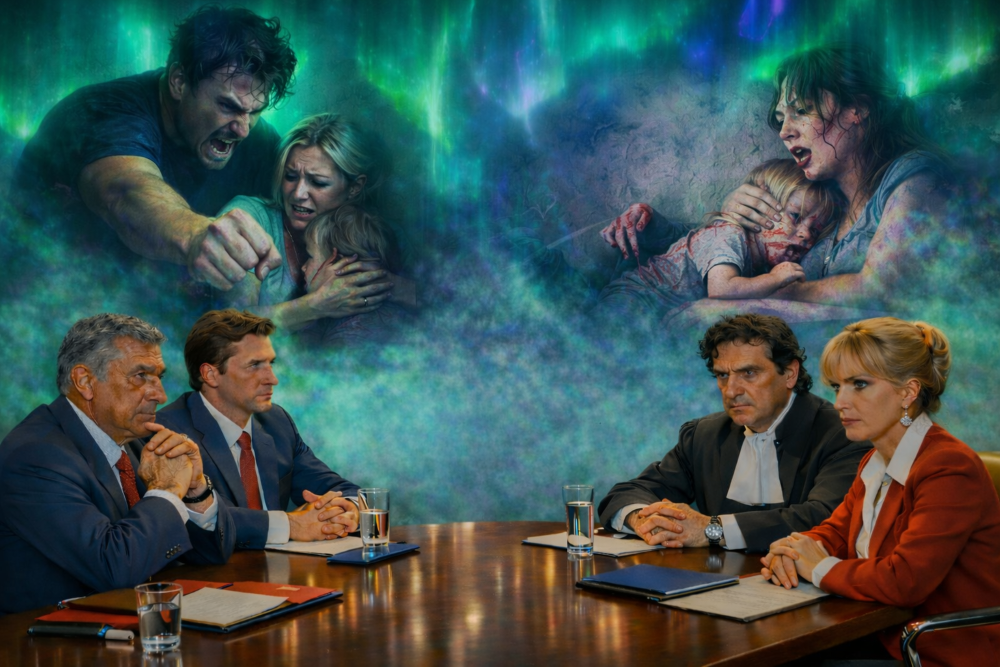
In the early hours of the morning, when the city is still quiet and the day has not yet fully taken shape, Amelia sits at the kitchen table with a cup of tea that has long since gone cold. A notification flashes on her phone from the banking app she cannot open, because the login code has been routed to Daniel’s device for months. Her debit card is kept “safe” in his jacket pocket, he says, so that no “unnecessary spending” can happen. Amelia’s salary does arrive, but it is almost immediately moved into accounts she cannot access; the same is true for the benefits and child allowance, which Daniel insists “have to be managed by him, because he’s the one who has the overview.” When Amelia carefully asks for money for groceries, there is no discussion—only an assessment: what exactly, why, how much, and above all whether it is truly “needed.” With every answer that fails to satisfy him, the conclusion is always the same: Amelia needs to learn how to handle money. Meanwhile, the letters pile up—letters she never gets to see. If mail does land on the doormat, it is often already opened. In the background, Nora calls out to ask whether there will be fruit for school today, and Amelia’s eyes drift to the empty fruit bowl as though it captures the entire reality in one image: there is money, but there is no access. The scarcity in the home is not the result of too little, but of a system in which resources are used as reins.
By midday, when the childcare provider calls to say the direct debit has failed, Amelia recognizes how the pattern constantly recalibrates itself to strike where it will hurt most. Childcare is the single hinge that makes it possible for Amelia to work, and for that very reason it becomes a pressure point. Daniel says it is “an administrative error” and that it will “surely work out,” but the last few times it only worked out after Amelia apologized for an argument she did not start. Later, when she tries to buy fuel so she can pick Nora up on time, the card is declined. At the pharmacy her prescription is left waiting because there is not enough balance. In the weeks that follow, Amelia discovers subscriptions in her name that she has never seen, and collection fees that trail her like a shadow: small amounts that turn into files, files that turn into barriers. When she tries to resume her training, there is “coincidentally” always chaos at home on class days, and “coincidentally” there is suddenly no childcare available. And when she finally takes the step to leave, the grip simply changes shape: child support becomes irregular, contact arrangements become a bargaining chip, and just when rent must be paid, a payment suddenly “cannot be made.” In conversations with outsiders, it sounds like money troubles, miscommunication, a difficult separation. In Amelia’s reality, it is a carefully constructed dependency, in which every missed payment, every blocked card, and every contract in her name serves the same objective: to preserve control, restrict movement, and steadily shrink the space in which it is possible to live safely and independently—for her, and for Nora.
No Access to a Bank Account, Card, or PIN
Amelia learns that control rarely begins with an explicit prohibition, but with a small shift that becomes irreversible in hindsight. At first it sounds almost reasonable: Daniel “handles” the banking because he is faster with apps and “better with numbers.” Then the shift hardens into an actual lockout. The PIN changes “for security reasons” and is not shared. The debit card is kept “just in case” in his wallet because, according to him, Amelia would otherwise be too impulsive. When Amelia asks for her own card, Daniel does not respond with a refusal that would immediately register as alarming to an outsider; he responds with conditions, questions, and insinuations—why now, what for exactly, and why it cannot go through him. The outcome is always the same, only the packaging changes. The household still has to run, Nora still has to get to school, food still has to be bought, but Amelia cannot pay for anything without first asking permission. Every practical act—groceries, transport, a new coat for Nora—becomes a moment in which Daniel can reaffirm who decides.
That daily dependency develops its own rhythm: Amelia learns to time her requests, to weigh her words, to defend expenses as if she were appearing before a committee. The amounts are not the instrument; the constant requirement to account for herself is. The scarcity is not produced by poverty, but by access-as-leverage. Even when money exists, the fridge can stay empty because Amelia asked at the “wrong” moment, used the “wrong” tone, or simply because Daniel wants her to feel—again—who holds the keys. In practice, this means Amelia cannot act independently when something goes wrong: a punctured tire, an unexpected school fee, a feverish child who needs medicine. The risk is not limited to inconvenience; it reaches into immediate safety. When escalation threatens, the ability to arrange transport or reach a safe place at once may be absent. The blocked card is therefore not merely financial; it is logistical and safety-critical.
Over time, the control becomes more technical and less visible as Daniel consolidates his grip. Bank alerts and authentication prompts go to his phone, not hers, giving him real-time oversight of transactions while he simultaneously controls the information. Digital access becomes a proxy for presence: even when he is not at home, he can decide whether Amelia is allowed to pay. If she attempts a password reset, confrontation follows immediately—how she dared, what she is hiding, whether she is “planning something.” Amelia comes to see that this is not about organization or efficiency; it is about engineering a situation in which every path to independence is pre-emptively blocked. The bank account is no longer a neutral tool, but the control panel through which Daniel governs the household and steadily compresses Amelia’s freedom of movement.
The Perpetrator Controls Salary, Benefits, and Child Allowance
In Amelia’s case, Daniel’s control of salary, benefits, and child allowance is the backbone of the dependency because it captures the income stream before it becomes usable in daily life. Amelia works, but the proceeds of her work do not translate into autonomy. Her salary may arrive, yet it is routinely redirected into accounts she cannot access or quickly swept away through transfers that she cannot verify. Daniel frames this as “budgeting” and points to bills, fixed expenses, and “everything that has to be handled,” but the decision-making power does not sit with Amelia. Benefits and child allowance—resources intended to support household stability and Nora’s needs—are treated as funds that belong to Daniel, not as provisions for the child. When Amelia mentions that Nora needs new gym shoes, the response is not a solution but a judgment: whether it is truly necessary, whether it can be cheaper, whether Amelia is grateful that he “carries everything.”
This arrangement produces two reinforcing outcomes. First, Amelia is economically hollowed out: there is no room to save, no buffer, no ability to set priorities on her own terms. Second, her credibility is undermined because Daniel can present himself as the responsible party—the one who “keeps things together.” Outsiders may hear that he manages the finances and assume stability, while Amelia experiences that the appearance of stability is precisely the instrument that keeps her stuck. The childcare call about a failed direct debit is emblematic: the money may exist, but payment fails when it suits Daniel. Amelia cannot correct it immediately because she lacks the access to pay or even to confirm what happened. Her daily schedule—work, school, childcare—becomes contingent on Daniel’s discretion, and Nora’s routine becomes collateral in a power struggle between adults.
As Amelia begins to contemplate leaving, this income control proves to be the most effective barrier. Opening a new account or switching benefits often requires digital access, correspondence, and breathing room—exactly the elements Daniel can disrupt. Updating records with agencies triggers letters and emails Daniel can intercept, verification codes he can capture, and flashpoints for escalation as soon as he senses Amelia making “movement.” Administrative infrastructure becomes a vehicle for continued coercion: slow processing times, system complexity, and assumptions of cooperative households create openings for a perpetrator to maintain control. For Amelia, each step toward independence is not just paperwork; it is a safety-sensitive action that must be managed carefully, because Daniel’s leverage lies not only in money, but in access to the systems that distribute it.
Debts and Subscriptions in the Victim’s Name
When Amelia finally sees fragments of the paperwork, it becomes clear that financial abuse is not limited to blocking access; it also involves actively manufacturing liabilities. Subscriptions appear in her name that she does not recognize—a phone contract, a streaming service, purchases made on installment plans. On their own they look like scattered items; together they form a mechanism that contaminates Amelia’s financial future. Daniel understands that debt is not only a sum; it is a chain. Arrears become collection fees, collection fees become records, and records become practical exclusion. It is precisely that exclusion—difficulty securing housing, normal service contracts, or basic financial flexibility—that obstructs departure and recovery. The perpetrator does not need to remain constantly present; the debt position continues to operate as delayed control.
In Amelia’s daily reality, the threat often becomes visible only when it has already advanced. Letters do not reach her or arrive already opened. Confirmations sit in accounts Daniel can access. Payments are “forgotten” at the moment their impact will be greatest, and Daniel then reframes the ensuing crisis as Amelia’s deficiency: she would be messy, irresponsible, unable to manage bills. The harm is therefore double—financial, as costs escalate, and social, as Amelia’s reputation erodes. When she seeks help and discloses that collections are pending, the risk is that institutions interpret it as “poor money management,” rather than as a coercive pattern deliberately engineered and maintained.
For Nora, the consequences are indirect but substantial. Debt constricts housing options, amplifies stress, and forces trade-offs around childcare, school expenses, and healthcare. The instability that follows is not neutral; it reshapes daily predictability and, in turn, a child’s sense of safety. That is why it is not enough to treat the debt load as a purely budgetary problem to be “fixed.” In Amelia’s case, debts are also evidentiary: contracts, collection notices, transaction histories, and digital logs can show how obligations were created in her name and how control was exercised around them. Only when debt is understood as part of coercion and control can recovery be built in a way that does not re-expose Amelia to Daniel through processes premised on cooperation or shared transparency.
Preventing or Undermining Work or Education
Amelia’s work and training plans represent a direct threat to Daniel’s control, precisely because they build independent income, independent networks, and an independent future. The sabotage rarely takes the form of a blunt prohibition that can be quoted cleanly; it more often appears as a pattern of disruption that outsiders do not see. On mornings when Amelia has an early shift, arguments “coincidentally” run late into the night. When she needs a conversation with her supervisor, Daniel calls repeatedly or sends messages that escalate the moment she does not respond. When Nora needs to get to childcare, the bag is suddenly incomplete, keys are “missing,” or Amelia is told at the last minute that childcare cannot be paid. Amelia is forced, again and again, to choose between work and crisis management—while the crisis is repeatedly manufactured by Daniel.
The result is predictable: absences, lateness, loss of focus, and ultimately the risk of job loss or stalled education. Daniel can then convert that outcome into narrative proof that he was right all along—that Amelia is unreliable, disorganized, incapable of managing life independently. It is a strategy in which sabotage and reputational harm operate together. For Amelia, work becomes not only a source of income but a frontline. Each step toward autonomy triggers countermeasures. Even when she makes it through the day, the effort required can be so consuming that little energy remains for recovery, parenting, or building a safety plan. For Nora, there is corresponding instability: changing childcare arrangements, tense mornings, a parent living in constant urgency, and the implicit lesson that daily life depends on the mood and decisions of one person.
Within a safety framework, this pattern cannot be reduced to “relationship problems” or generic work–family strain. In Amelia’s case, the disruption is functional; it is designed to prevent economic independence. Evidence may sit in schedules, childcare communications, messages that spike around shift times, and repeated incidents just before key commitments. Interventions that rely solely on “making agreements” can increase risk by giving the perpetrator a new arena for pressure. Effective support treats work and education as protective factors and organizes practical safeguards accordingly: stable childcare, reliable transport, and, where needed, discreet channels to employers or educational institutions for support, without providing Daniel information he can use to refine the sabotage.
Imposing “Fines,” Withholding Money, and Deepening Dependency
In Amelia’s case, the system of “fines” is not an isolated cruelty; it is a deliberately constructed disciplinary regime. Daniel ties money to behavior as though he were enforcing an internal sanctions policy: if Amelia talks to someone for “too long,” if she is “disrespectful,” if she does not appear “grateful,” then money is withheld. Sometimes the punishment is explicit—no grocery money this week—and sometimes it is subtler, such as delaying a payment until Amelia “calms down.” The effect is the same: Amelia learns that basic financial security is not a right but a privilege that can be revoked. The standards are intentionally vague so that she can never fully comply and Daniel can always find a pretext to penalize her. The household is thus governed by fear of arbitrary consequences, not by planning.
The immediate harm is tangible. When money is withheld, the fallout is borne not by Daniel but by Amelia and Nora: an empty fridge, a cancelled bus trip, delayed medication, a bill that slips past the deadline. Daniel can then use the resulting disruption as further “proof” that Amelia causes chaos. A closed loop forms—sanctions create shortages, shortages create stress and mistakes, and those mistakes become the justification for new sanctions. For Nora, this becomes a pervasive uncertainty attached to ordinary life: whether there will be food, whether sports can continue, whether a school activity is possible. The child is not merely a witness to control, but an involuntary bearer of its consequences, without any influence over the cause.
A defining feature of the case is Daniel’s ability to package these “fines” in language that can later be recast as reasonable: “discipline,” “agreements,” “consequences.” In messages he can sound controlled, while the threat sits in the dependency he has engineered and the outcomes he can trigger at will. That is why, in evidence and intervention, it is not enough to scrutinize tone; outcome and repetition matter more. Chats where conditions are set, bank histories showing withheld access or diverted funds, and recurring patterns of missed essential expenses together demonstrate a system, not isolated incidents. A safety-centered response aims to remove the sanction lever altogether: independent access to funds, a separate account, and practical buffers around core bills. As long as Daniel retains the ability to use money as a punishment button, control remains intact—even when the language grows softer.
Insufficient Money for Food, Transport, and Medication
In Amelia’s case, the lack of money for food, transport, and medication is not a side effect of a tight budget; it is manufactured scarcity, deployed as quiet coercion. There are mornings when Amelia knows her salary has been deposited and that benefits have come in, yet the fridge remains bare because she simply cannot pay. Daniel controls not only how much is “available,” but when it is available and on what terms. The household continues to look functional from the outside, but it is in fact engineered to hover at the edge of disruption. When Nora asks whether there will be fruit for school, Amelia finds herself improvising—not because resources do not exist, but because access has been monopolized. Basic needs are converted into negotiations, and negotiations are converted into opportunities for Daniel to reinforce that dependence is the default condition.
The consequences are immediate and cumulative. Amelia skips meals so that Nora can eat, and the fatigue and stress begin to erode her focus—an erosion that Daniel later points to as proof that she is “disorganized” or “incapable.” Transport becomes a separate vulnerability: if the card is declined at the petrol station or there is no money for public transit, appointments are missed—medical visits, school meetings, conversations with support services. Medication becomes part of the mechanism as well: a prescription left unfilled, a pharmacy bill left outstanding, a necessary purchase deferred until “later,” with “later” always turning into the next leverage point. With a child in the home, the effect is a collapse of predictability: meals become uncertain, routines fracture, and the primary caregiver is pushed into permanent crisis management rather than stability.
This scarcity also operates as a safety lock. Without money for transport or communication, Amelia’s ability to mobilize help becomes sharply constrained—especially at the moment an escalation threatens. Daniel can exploit that constraint with precision: when Amelia asserts a boundary or withholds compliance, money is “temporarily” withheld, and the practical options to leave, seek advice, or arrange emergency support narrow. Evidence of this pattern may appear in missed appointments, pharmacy records, messages refusing essential expenses, and bank statements showing income that is not matched by spending on necessities. From an intervention standpoint, securing access to basic resources is not a comfort measure; it is primary risk reduction, directly tied to Amelia’s capacity to act when safety is on the line.
After Separation: Child Support and Contact as Leverage
When Amelia takes steps to leave, the form of control changes, but the objective remains intact. Instead of daily gatekeeping inside the home, Daniel shifts to strategic unpredictability around child support and contact arrangements, merging money and parenting logistics into a single instrument of pressure. Payments arrive late, partial, or not at all—often in the very weeks when costs peak because Amelia is carrying rent, childcare, and new household expenses. When Amelia asks why, she is met not with an explanation but with an implied condition: if she “cooperates,” if she “stops making trouble,” if she “doesn’t interfere” with contact, then the money will come. The message mirrors the past—basic stability is made contingent on compliance—only now it is routed through post-separation obligations.
For Nora, the harm is both practical and emotional. Irregular support undermines Amelia’s ability to budget, placing school costs, clothing, and activities under pressure. At the same time, Daniel can perform reliability in front of others, suggesting that he “pays everything” or that Amelia is “being difficult,” while Amelia is left absorbing the shortfall. Contact becomes part of the same negotiation. Daniel can change plans at the last moment, complicate handovers, shift costs, or threaten to withhold contributions when Amelia insists on predictability for Nora. In this configuration, parenting time is not simply a scheduling matter; it becomes a lever for destabilizing daily life and for drawing Nora into a loyalty conflict, where the child senses that money and contact are always tied to adult tension.
A safety-centered reading requires distinguishing coercive leverage from ordinary post-separation disagreement. Patterns matter: payment histories, repeated conditional statements, and the consistent coupling of money to compliance indicate purposeful control rather than mere disorganization. Approaches that rely on informal “working it out” can amplify risk, because they give the controlling party a fresh arena for pressure and renegotiation. The stabilizing objective in Amelia’s case is predictability: dependable financial flows and contact structures that do not depend on ad hoc bargaining, so that Nora’s daily life is no longer exposed to a reward-and-punishment cycle disguised as co-parenting conflict.
Financial Sabotage at Critical Moments
In Amelia’s case, financial sabotage becomes most visible at the moments when a payment or decision could widen the pathway to independence. The failed childcare direct debit is an example precisely because childcare is not merely an expense; it is the infrastructure that allows Amelia to work and to build exit options. Daniel does not need to say openly that he wants to block her progress; it is enough to let a payment “accidentally” fail and then make the fix contingent on Amelia’s submission. Rent is another predictable pressure point: just when rent must be paid, funds are suddenly unavailable, a transfer “cannot be made,” or the account is “having issues,” even though other spending later occurs without obstacle. The timing is the signature. It is not about saving money; it is about destabilizing the system at the point where stability matters most.
The impact is disproportionate because fixed costs and child-related services have little tolerance for delay. A missed childcare payment can trigger suspension, forcing Amelia to miss work and lose income. A late rent payment can bring warnings or enforcement steps, pushing Amelia’s attention away from safety planning and toward constant triage. The pattern produces cascading harm: one disruption becomes multiple crises, and Daniel can then cite the resulting chaos as evidence that Amelia is the problem. Nora experiences this not as isolated incidents but as a household where plans dissolve at the last minute and tension spikes around deadlines. In that sense, sabotage functions as environmental violence: the home becomes a place where predictability is repeatedly punctured exactly when predictability is most needed.
Proof is often found in recurrence and concurrence. Bank statements may show unusual withdrawals or transfers just before critical due dates. Emails from childcare providers or landlords can document the immediate consequences. Messages in which Daniel minimizes the issue, delays payment, or shifts blame add context to the timing. Effective intervention focuses on closing the sabotage points in advance: routing key bills through accounts under Amelia’s sole control, establishing emergency buffers for critical dates, and restructuring obligations so Daniel has fewer opportunities to trigger a domino effect at moments that threaten Amelia’s stability.
Evidence: Statements, Contracts, Collections, and Emails
In Amelia’s case, evidence rarely appears as a single decisive document; it is assembled as a mosaic that exposes the gap between appearance and reality. Daniel may claim that he “handles the administration,” but bank statements show whether money was actually available and where it went. Contracts reveal which obligations were placed in Amelia’s name and when. Collection letters demonstrate how quickly costs escalate and how missed payments become formal enforcement. Emails and messages show how permission, conditions, and punishments are communicated. Taken together, these materials do not simply describe financial difficulty; they establish a pattern of coercion and control—restricted access, strategic destabilization, and the deliberate shifting of liabilities onto Amelia.
Bank records can be particularly powerful when read for timing, frequency, and discrepancy. They can show recurring transfers to accounts Amelia cannot access, unusual cash withdrawals around key deadlines, and a mismatch between incoming income and spending on essential household needs. Contracts and subscription confirmations can be linked to digital access patterns: an email confirmation in an account Daniel controlled, a collection notice that never reached Amelia because mail was intercepted, or messages in which Daniel dismisses a need while the corresponding bill remains unpaid. The factual trail allows a reconstruction of decision-making power: who controlled the channels, who benefited, and who bore the consequences.
Just as importantly, evidence gathering must be treated as a safety issue in its own right. If Daniel has access to devices, cloud storage, or email accounts, documents can be deleted—or the mere act of collecting them can trigger escalation. Safe storage, discreet duplication, and careful separation from shared accounts reduce that risk. A strong file does more than list incidents; it ties them together with a coherent timeline and supporting documents, making the pattern intelligible to agencies and professionals who might otherwise misread the situation as “poor budgeting” or “relationship conflict.”
Intervention: Budget Safety, a Separate Account, and Safety-Aware Debt Support
In Amelia’s case, intervention is effective only when financial measures are treated as safety measures. “Budget safety” means predictable, independent access to resources, insulated from Daniel’s ability to block, monitor, or punish. A separate account with exclusive access is not a preference; it is a protective condition. That includes secure digital access, a dedicated email address, authentication methods Daniel cannot intercept, and correspondence that cannot be redirected or opened. Redirecting salary, benefits, and child-related payments into that safe infrastructure is central, because it restores the economic oxygen Amelia needs to stabilize housing, childcare, and healthcare—and to protect Nora’s daily routine from manipulation.
Debt support must be explicitly safety-aware. Standard processes—joint appointments, shared documentation channels, or assumptions of cooperative disclosure—can be dangerous where coercive control is present, because they hand the controlling party information and leverage. Safety-aware support recognizes that some debts may have been created under pressure or without genuine consent, that mail may have been intercepted, and that escalation may follow any sign of stabilizing momentum. The immediate priority is often triage: securing housing, utilities, childcare, insurance, and medication, while preventing new liabilities and containing enforcement risk. Only after core stability is protected can broader restructuring proceed without inadvertently increasing exposure.
Finally, intervention should systematically reduce the points Daniel can use as levers. That means minimizing financial interdependence, restructuring payments so they cannot be blocked, and building buffers around critical deadlines. It also means practical accompaniment: help with switching benefit destinations, restoring digital control, communicating safely with agencies, and building a calendar of high-risk dates. In a household with a child, every financial safeguard should be tested against its impact on predictability for Nora, because in this context “financial stability” is not an abstract goal; it is food, transport, medication, school continuity, and a living environment where daily life is no longer hostage to someone else’s discretion.